
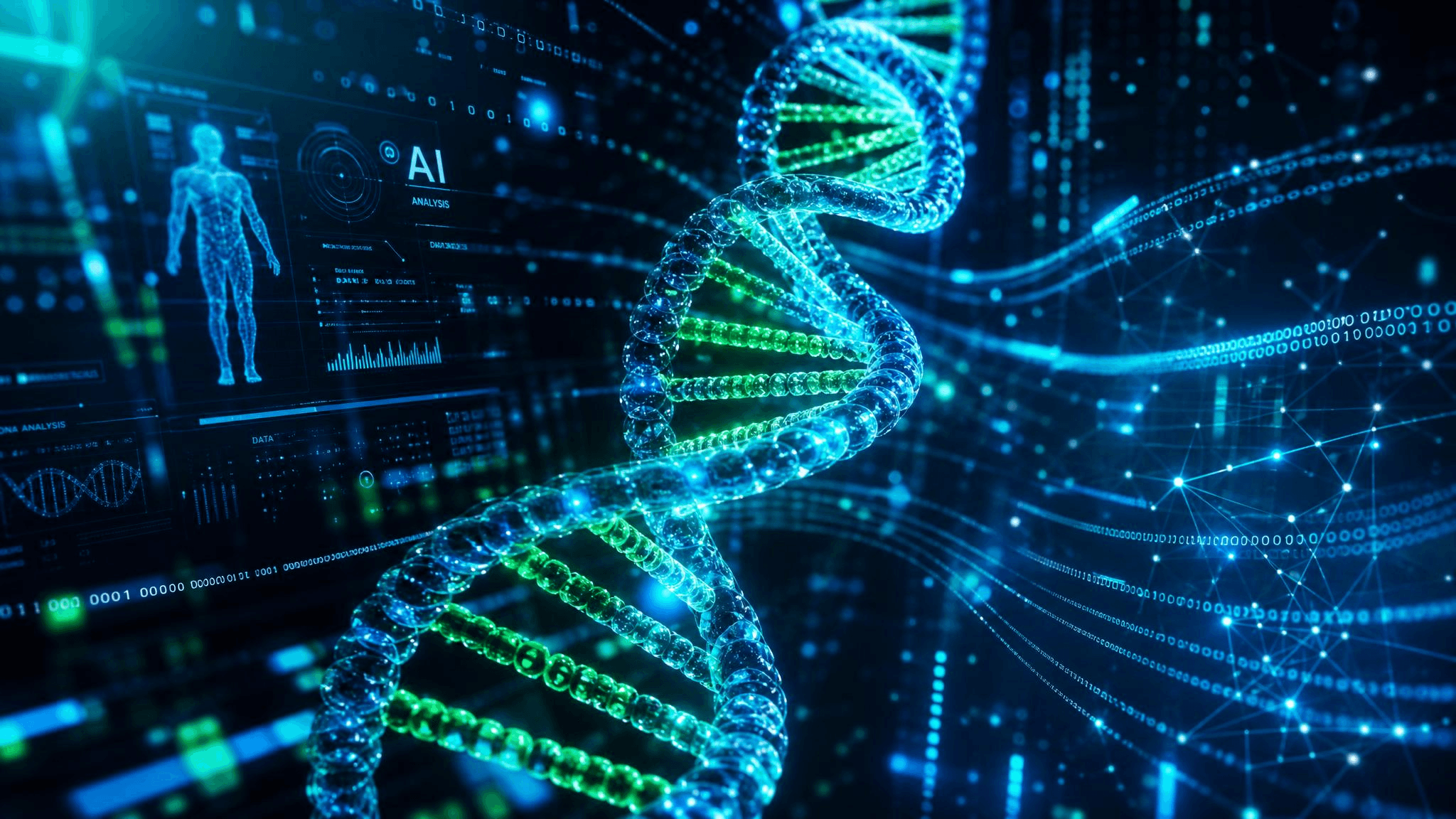
They Can Read Your DNA Now
Google AlphaGenome reads the parts of your DNA we never understood. The science just arrived. The ethics are still loading.
On June 25, 2025, Google DeepMind did something that sounds like science fiction.
They released AlphaGenome. It reads the dark matter of human DNA. The parts we called junk because we could not read them. It handles sequences up to one million base-pairs. That is like reading a novel when we used to struggle with sentences.
The model predicts gene expression. It anticipates mutation effects. It interprets the regulatory regions that control when and how genes activate. This is not just data analysis. It is pattern recognition at a scale no human team could achieve.
What This Actually Means
Personalized medicine becomes actually personal. Drug development timelines could compress from years to months. Rare disease diagnosis gets a tool that sees what specialists miss.
Imagine walking into a doctor's office with a condition that has stumped three specialists. The doctor runs your genome through AlphaGenome. Twenty minutes later, they understand what is happening at the genetic level. Not because the doctor became smarter. Because the tool can see patterns humans cannot.
Or consider drug development. Right now, bringing a new drug to market takes ten to fifteen years and billions of dollars. Most of that time is spent on trials that fail. AlphaGenome can predict how different genetic profiles will respond to different compounds. The failures happen in simulation instead of in human trials. The successes get to patients faster.
For rare diseases, this is transformative. Most rare conditions affect too few people to justify massive research budgets. Pharmaceutical companies cannot make money developing treatments for diseases that affect thousands instead of millions. AlphaGenome changes the economics. When you can predict genetic effects computationally, you can develop treatments for smaller populations profitably.
The Weight of This
But here is what keeps me up at night.
Your genetic code is your most private data. It is more specific than your fingerprint. More revealing than your medical history. More permanent than anything else that defines you.
AlphaGenome makes it readable. Who gets to read it?
Insurance companies would love this data. They could predict your health risks with precision. They could price coverage based on your genetic likelihood of developing conditions. They could deny coverage altogether for high-risk profiles.
Employers would love this data. They could screen candidates based on genetic predispositions. They could make hiring decisions based on predicted health outcomes. They could build teams optimized for genetic resilience.
Governments would love this data. They could predict population health trends. They could identify genetic markers for behavior. They could build profiles of citizens at the molecular level.
None of this is happening yet. All of it is possible.
The Questions We Need to Answer
Who owns your genetic data? You? The company that sequenced it? The AI that analyzed it? The hospital that stored it?
Who decides what the reading means? The AI outputs probabilities. Humans interpret those probabilities as diagnoses, predictions, recommendations. Where does the AI's responsibility end and the human's begin?
What happens when the AI is wrong? AlphaGenome is powerful. It is not perfect. A false prediction about genetic risk could lead to unnecessary treatments. A missed prediction could lead to untreated conditions. Who is liable when AI-driven medicine fails?
How do we prevent genetic discrimination? We have laws against discriminating based on race, gender, age. We do not have comprehensive laws against discriminating based on genetics. The GINA act in the United States provides some protection. It is not enough.
The Bigger Picture
This is not just about AlphaGenome. This is about the entire field of AI-driven biology. We are building tools that can read the code of life. We are not building the ethical frameworks to use them responsibly.
The technology is advancing exponentially. The regulation is advancing linearly at best. The gap between what we can do and what we should do is widening.
AlphaGenome is a breakthrough. It is also a warning. We now have the power to read human biology at unprecedented scale. We need to develop the wisdom to use that power well.
The science just arrived. The ethics are still loading.
The AI Sessions is where creators, musicians, and curious minds gather to explore what is actually happening in AI -- before it hits the mainstream. New drops weekly. No fluff. Join the list. |

0 Comments
Join the conversation
Be the first to comment
Share your thoughts above.